Friday, 11 August 2017

Valerian and the City of a Thousand Planets

"It's independent. It's not superheroes defending the power of America. It's European - it's different - and they can't accept that."

That was Luc Besson, talking to the Sydney Morning Herald about why he thinks his latest film has tanked at the US box office. As the interview goes on, you can sympathise with Besson to some degree. His frustrations lie with a market that has become saturated with identikit Marvel franchises; Valerian, to his credit, does indeed stand out as something different. It's nothing if not pure sci-fi in its most outrageous, nerdgasm-inducing form.

But different as in 'good'? Different as in 'better'? Different as in 'superior in quality, with characters you can root for and a story you care about'? Sadly, the answer is no. In an attempt to bring to the screen a graphic novel he's cherished since he was ten, he's forgotten the basics. It's not rocket science, Luc.

Usually I'd go over the plot essentials, but it's borderline immaterial here. Valerian (Dane DeHaan) and Laureline (Cara Delevingne) are two space dicks amidst loads and loads of other space dicks. For balance, some aren't so dickish and are actually quite nice, even if their CGI rendering isn't. Rihanna is in it for a bit. She plays a shape-shifting stripper who's been plying her trade since the age of four. I nearly did a bit of sick in my mouth when she says that. I know the film is European, but that's a bit much even for my hardy tastes.

Its main flaw (and there are many, trust me) seems to be its two leads. DeHaan and Delevingne are entirely devoid of screen charisma, her Laureline utterly obnoxious with her post-millennial, faux-apathetic bullshittery. She comes off as some sort of spoilt rich girl who by law is required to rebuff her counterpart's advances, but not in any satisfying, meaningful way that feels empowering. She's just an arsehole. Not that I blame her, to be fair - DeHaan's Valerian is a sleazy jock sad-act with terrible hair. Both of them have a thing about playlists signifying their compatibility. It's a joke (as in it really is an absolute joke) that bookends the film, both times falling completely flat. Rutger Hauer is also in it, something I'd forgotten by the time I came to write this review.

Clive Owen's in it too, and has a blackhead on his lip that make-up didn't cover up. It's really noticeable towards the end when he goes a bit General Zod, screaming that he's making very bad decisions for the good of everyone else, when really he's just a prick and everyone knows it (a bit like Clive Owen in general. Though maybe he's lovely, who knows). There's lots of people who are in it, actually - Herbie Hancock, for instance. No idea why. Same goes for Ethan Hawke, putting in possibly the worst performance of his entire career. Seriously, it's bloody awful. Worse than Jake Gyllenhaal in Okja. Okay, not that bad. But pretty bad all the same.

Valerian is a film of stuff happening. All the time, constantly, stuff here and stuff there. It's full of it. No let-up. It would be draining, were it in any way actually exciting (see The Fifth Element for an example of how this entire operation was done far better - almost verbatim - by Besson himself, twenty years ago). It's unabashed eye candy, neon-hued and 3D-accelerated to breaking point. Exhausting for the eyes, yet dull for the senses. $210m it supposedly cost. That's over four times as much as Arrival. Almost eight times as much as La La Land. Fifty-six times as much as Best Picture Oscar-winner Moonlight. Spending inordinate amounts of money on a film is no guarantee of quality, and both audiences and critics know it (see Transformers: The Last Knight).

What adds insult to injury is the fact the film was crowd-funded. Yes. Mugs like you and me paid for this overblown, charmless, two-hour PlayStation cutscene of a movie. If I'd have contributed financially to it in any way, I'd be writing Besson a strongly-worded letter demanding an explanation for such dire casting, appalling scripting and why the fuck Rihanna was in it, let alone how much she got paid. "It's European - it's different - and they can't accept that" Besson protests. No, it's not tanked because it's different. It's because it's shit. And the bar is set quite low these days when it comes to the Marvel films he's apparently taking on; crowd-pleasing they may be, but innovative they are not. If you're going to be inventive, try and remember the basics. It's not rocket science, Luc.

Sunday, 30 July 2017

Baby Driver

Edgar Wright is a bit like Pixar. You think he can do no wrong (Spaced, Shaun of the Dead, Scott Pilgrim), then he goes and makes the unfunny, genre-confused clusterfuck that is The World's End (I honestly couldn't care less if it's Certified Fresh on Rotten Tomatoes - all the other critics are wrong, because it is shit). Well, a good run has to end at some stage. Just like Cars 2 was a blip on an otherwise upward trajectory (okay, throw in Monsters University and The Good Dinosaur in there for good measure - Pixar have made more than he has), it made Wright's follow-up - in this reviewer's eyes at least - have all the nail-chewing appeal of root canal treatment.

Okay, so that's a bit of an exaggeration. But when the first trailer for Baby Driver was released (I refuse to say 'dropped'), I viewed it with brow-furrowed trepidation. A supposed jukebox musical with all the stock crime-and-cars thrills of a modestly-budgeted Fast and Furious knock-off. But The World's End was just a blip, right? Well yes, as a matter of fact, it was. Baby Driver is nothing if not original (well, as original as anything can possibly get these days) and sits comfortably alongside Wright's best work - possibly even right at the top of the pile.

Having survived a car accident as a child, which killed his parents and left him with severe tinnitus, the only way the titular Baby (Ansel Elgort) can drown out the noise is by carting round a selection of iPods with various playlists he's curated. Under the watchful eye of Kevin Spacey's Doc - a charming but cut-throat rich guy with a nice line in planning elaborate robberies - Baby has become his go-to getaway driver, repaying a debt with each robbery he assists with.

There's all manner of classic tropes on offer here - the good kid trying to right a wrong, an evil boss, a rogue's gallery of hoodlums (Jamie Foxx, John Hamm, Eliza Gonzáles) - plus a love interest in Lily James's Debra who, if not quite out of the manic pixie dream girl playbook, certainly peddles enough sunshine-hued fresh-faced beauty to beguile Baby and make him dream of a life away from crime. Which obviously is going to be put to the test because, well, how else would these things go?

It sounds so unambitious and generic on paper but trust me, it isn't. The alleged 'jukebox musical' term isn't entirely accurate, the film opting to use Baby's playlisted songs as a jumping-off point for action sequences and audio-synchronised gun battles that initially reminded me of the godawful Clive Owen / Paul Giamatti vehicle, Shoot 'Em Up (again, let's not dwell on the fact that many critics liked this too. They are all incorrect, for it is rubbish). Suffice to say, Baby Driver pulls off exactly what that film was attempting to do with a tank load of style, charm and razor-sharp wit in reserve.

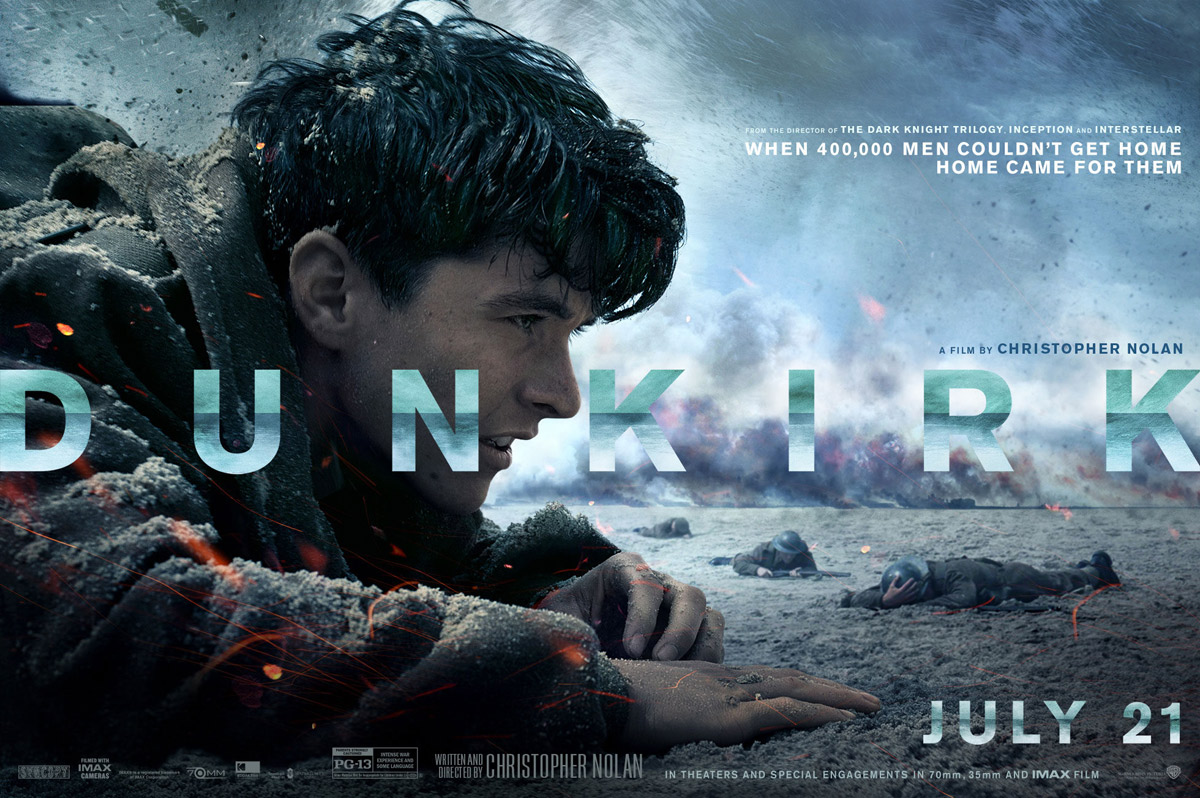
Putting relative newcomer Elgort front and centre was a canny move, too. Hanging a roster of A-listers off the back of a fresh face isn't a new concept, but it allows Elgort to more or less sit back and let the big boys do the heavy lifting while he concentrates on kicking ass and chewing bubble gum (okay, wearing sunglasses and listening to Queen). Christopher Nolan has gone this route too for Dunkirk, the film's literal poster boy Fionn Whitehead the kind of anonymous but model-beautiful central character you can place your Tom Hardy's and your Kenneth Branagh's around, letting them do the big acting while the audience walks in the boots of the everyman.

It feels like Wright may have made Baby Driver - whether intentionally or not - as a backhanded fuck-you to the studio system that turfed him off Ant-Man. It manages to tick all the boxes a studio would want (action, comedy, drama, a marketable cast) whilst also having an essential ingredient which too many studio pictures panic about these days (an original script with genuine heart), plus an indie spirit which meant no CGI when it came to the car chases. No matter how fast and furious Vin Diesel and Dwayne Johnson might be, when you know a driver is pulling those stunts for real, it adds a layer of tangible reality that CGI simply cannot emulate (see Rogue One's Peter Cushing for another example of this dilemma - almost there, but not quite).

While there's already talk of a sequel, Baby Driver feels like it should be a one-off, a standalone work to show aspiring filmmakers it is possible make unapologetically commercial cinema without having to sacrifice the earth. It ticks over at an unrelenting pace without ever feeling rushed or compromised, a cavalcade of ideas both old and new thrown into a mixer with all the best stuff sticking. It's how blockbusters should be. On which note, I'm off to book tickets for Pixar's Cars 3. I mean, it was just a blip, right...?

War for the Planet of the Apes

Downer films - at least ones costing north of $150m - are in short supply these days. With the shambolic state of the world of late, it could be argued that's no bad thing; no-one wants to be emotionally pummelled by a film only to walk out into the shit sandwich of actual reality. But sometimes, when the allegories run so close to home that a story takes on more meaning than perhaps its creators originally envisaged, a film fizzing with nihlism and fatalism becomes wholly necessary. I'm going on record (for now at least) to say that War for the Planet of the Apes is my film of the year - a downer film for the ages perhaps, but one that had me enthralled and exhilarated from the first frame to the last.

In a handy recap for anyone not quite up to speed with the current Apes series, the film opens with brief plot outlines of what's already happened to get us where we are. Caesar, an ape who's intellect was greatly enhanced due to his owner's experimentation with a cure for Alzheimer's (experimentation which led to the outbreak of so-called 'simian flu', all but wiping out the human race) leads his species in an ongoing struggle between apes and humans - a battle started by Koba, a fellow ape experimentee who's lust for war ultimately led to his death at the hands of Caesar.

While Caesar wants nothing more than for apes and humans to live separately and in peace, the surviving humans fear the apes will become the dominant species and "treat humans as their cattle" - or so says Colonel McCullough, played with typical Southern charm/menace (delete as appropriate) by Woody Harrelson. Far from being a one-dimensional villain, McCullough has sound reason and logic behind his aggressive sentiments, very much a Joker to Caesar's Batman (I'm not sure that metaphor works, but I'm standing by it).

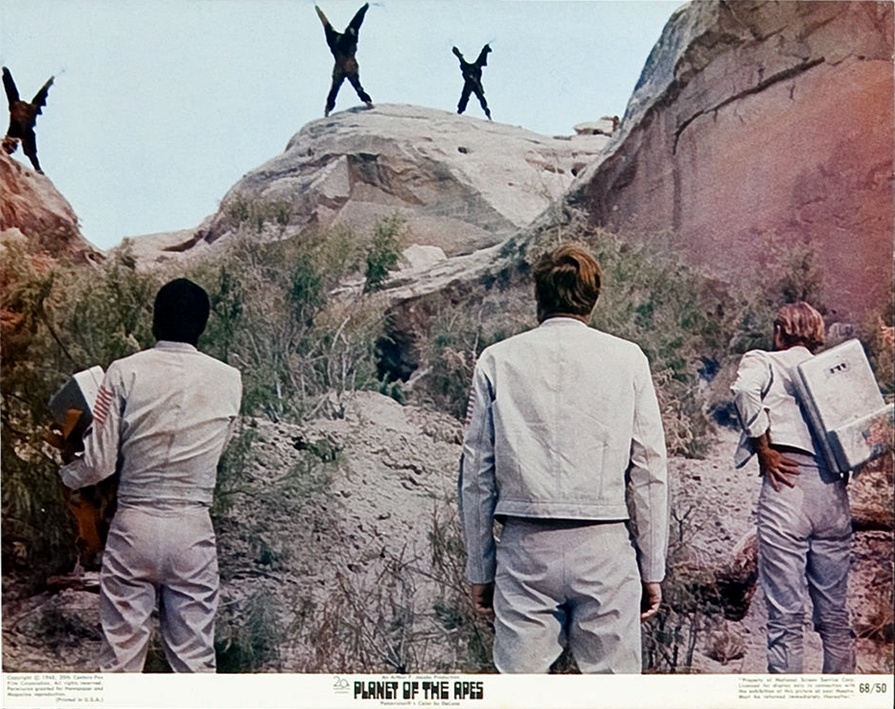
McCullough has militarised a faction of remaining humans who are immune to the simian flu, caging up apes and creating what amounts to a concentration camp, complete with makeshift ape crucifixes (or rather 'scarecrows', for anyone familiar with the 1968 original) and a nice line in underground tunnels that would be a perfect escape route for the apes he's rounded up. Surely not...

It's this layering of emotionally-complex characters and allegorical brutality that gives War... a level of depth and nuance that is sorely lacking from too many franchise films these days. Director Matt Reeves - having already proved he could steer the franchise in a daring direction with the previous sequel - doesn't attempt to box-tick what he thinks an audience wants. It feels far more personal than any tent-pole studio film has any right to. However the real surprise lies in the structure. Far from being the war movie the title suggests, War... takes a slow-burn approach to what is essentially a riff on The Great Escape via Apocalypse Now, but with moments of unswerving horror that would struggle to pass censors if it wasn't for the fact it's CGI apes getting whipped and executed, not humans.

Not content with stripping back the action to a bare minimum and focusing on character development (I know, a good script - who'd have thought it?!), War... has great fun introducing new folk into the mix - namely the unbearably cute Bad Ape (a note-perfect Steve Zahn) who brings some subtle but much-needed comic relief to proceedings; and Nova, a mute young girl who's name - like the crucifixes - calls back to the 1968 original without feeling crowbarred (how she gets her name is one of the film's myriad touching moments).

While War... feels like a the end of a trilogy, more often than not these things never are. You could quite easily remake the original from this juncture (admittedly with the help of a two-thousand year fast-forward button) and continue rebooting apace. But Reeves has already suggested there's more stories to tell, not least with the introduction of Bad Ape, who's inclusion in the narrative hints at a wider ape evolution that we as viewers haven't yet been privy to. If further films are of this quality - downers though they may be - consider me signed up for the lot.

Dunkirk

You've not seen a fly until you've seen it in IMAX. Honestly, about six feet wide it was. All over the gaff, for a good forty minutes. Tom Hardy valiantly tried to gun him down from the cockpit of his Spitfire at one point, but it was to no avail. Such was my experience of Dunkirk, in stunning 15/70. Half of it ruined by a fucking bluebottle.

But I do digress. Despite the wing'd distraction, Nolan's latest (and shortest since his indie debut, Following) convinces as a technical marvel, a giant-sized paean to the despair and bravery of 400,000 men trapped on a beach in France, with hope of rescue fading as each ticking second passes (something Hans Zimmer's propulsive score acknowledges with an incessant urgency, even if it all goes a bit Chariots of Fire towards the end). With absolutely zero character development, Nolan's desire was to construct a film made up entirely of a third act climax, spread over the entire running time. And it almost works.

Focusing on the three perspectives of land, air and sea, it plays with time in a way many have compared to Inception (air = one hour; land = one day; sea = one week). But unlike Inception, it's not necessarily required to know exactly what's going on when; the timelines gel in a masterstroke of editing complexity that may very well be analysed by film scholars and cinephiles alike. Scenes play out from various viewpoints at completely different junctures, depending on where the three timelines are up to. It can feel somewhat haphazard on first viewing, but second time round it reveals itself as a wholly cohesive triumph.

Not unlike Alfonso Cuaron's Gravity, Dunkirk feels almost like an extended, immersive theme park ride - a visceral experience driven by thunderous audio and overwhelming visuals from start to finish. In this regard, despite quality performances from all cast members (including Nolan's good luck charm Michael Caine - answers on a postcard if you can spot him), the film takes on a sort of monolithic, impenetrable nature; at once throwing you head-first into the firing line, but at the same time leaving you slightly detached from it all.

Its unique ambition in being often solely driven by tension rather than character is no doubt part of the reason one feels a lack of investment in any of the main players. That said, by the time he's flying sans-fuel over the beach front, picking off Jerries and pulling back his cockpit to feel the wind in his face, I was definitely not detached from Tom Hardy. What an absolute man. I would gladly have his babies any time that suits.

A second viewing definitely helps with Dunkirk, such is the onslaught of sound and fury it brings to the table. But Nolan's best film, as some critics are hailing it? Not quite. When the credits of The Dark Knight hit the screen back in 2008, the grin across my face was a mile wide. While Dunkirk hits many of the same Nolan-flavoured notes, its deliberate lack of anything approaching conventional storytelling tropes cannot be ignored. A colleague of mine claimed it was experimental in nature, and he's not far wrong.

But then it's unfair to compare the two, Nolan stating he wished to challenge himself by doing something completely out of the confines of genre filmmaking he's become known for. Much as I love MementoThe PrestigeInterstellar et al., Dunkirk at least shows Nolan wants to stay (vaguely) fresh, even if his films - not unlike Spielberg or Hitchcock - have a distinct Nolan-esque vibe that cannot be shaken. But then not unlike his aforementioned peers, he's a crowd-pleaser. And in an age of endless franchises with studios afraid to gamble on anything approaching original - let alone borderline experimental - that's nothing to be sniffed at. I'd choose his latest over the next Transformers film any day of the week. Giant flies and all.


ADDENDUM: I missed the first ten minutes of my second viewing due to the 2.20:1 aspect ratio being incorrectly projected. I seriously cannot catch a break with this film. Film something in NormalVision next time, Nolan. Cheers.

Sunday, 26 February 2017

The Oscars 2017

Despite all credible journalistic outlets already having made their predictions and tips for Oscar success this year, it felt pertinent to do my own blog at the eleventh hour - not least because I agreed to host HOME's Digital Content Manager, Sarah Leech, at our gaff for viewing purposes. I've watched the ceremony several times now, with my good lady generally falling asleep around the 4am mark, often streaming from some hooky webcast that goes down every forty minutes prompting a flurry of panicked clicking and pop-up blocking in order to find another pirate stream. But NOW TV came to our aid last year, reducing stress levels significantly (that said, Alex Zane and Dr. Quinn Medicine Woman can get in the sea if they show up again between ad breaks).

(I've just checked - Alex Zane IS presenting. Please Sky, I'll suffer Zane and Boyd Hilton for five and a half hours so long as Jane Seymour is kept under lock and key.)

This year's ceremony will no doubt be politicised by those making acceptance speeches, and rightly so - anyone with a platform and a dissenting voice loud enough should be heard in these worrying times, irrespective of how many may actually take note. But when all's said and done, the show is about the films and the films alone - yes, even Florence Foster Jenkins, starring the failing overrated so-called actress Meryl Streep (nominated for Best Actress, obviously). Here's my take on those up for the big gongs, and a few of the not-so-big gongs too:


Arrival

I won't lie, big budget serious sci-fi thinkpieces like this push all the right buttons for me. Your Moonlight's and your Manchester by the Sea's aren't what I really want to be watching more than once, no matter how much act-ting they throw at you. Also it's bloody great to see a genre piece up for a hefty haul of nominations (eight, including Best Picture and Best Director) when they're so often sidelined in favour of films deemed far more important (I'm willfully ignoring LOTR: The Return of the King for this argument to work). Think of Contact meets Donnie Darko and... no wait, that's an awful way to describe it. But it's got a bit of time travel involved and it made me cry upon second viewing. Amy Adams should have been nominated for Best Actress.

PREDICTIONS: Sound Mixing


Fences

All men are bastards. It's a fact, and Denzel Washington's film version of August Wilson's play of the same name takes a whopping 139 minutes to tell us. That's not to say the film doesn't have something to say - it just takes far too long saying it. The fact the film also sticks rigidly to its stage-bound roots, largely taking place in the back yard of the house shared by Washington's Troy Maxson and his wife Rose (Viola Davis) means it rarely feels cinematic in any sense of the word, even though the story is strong and the performances excellent (Washington's Troy is possibly the most complicated and tragic character he's ever portrayed).

PREDICTIONS: Viola Davis will be pipped to the post by Naomie Harris for Supporting Actress


Hacksaw Ridge

Taking influence from war films of the 50s and 60s that colour events with a rose-tinted hue of selfless optimism and Christ-like heroics, Mel Gibson's return to the director's chair is a world away from The Passion of the Christ in one sense, but not entirely dissimilar in another. Much like Full Metal Jacket or Life is Beautiful, it's a film of two distinct halves; the schmaltz is layered on thick during the backstory, before heads are blown off and limbs strewn across the battlefield as Andrew Garfield's Desmond Doss proves exactly how a pacifist medic can be of use at the battle of Okinawa. Based on a true story, it cranks up the cheese but also the tension; a film out of time that lives or dies by how much you buy into Garfield's gee-whizz heroism.

PREDICTIONS: Sound Editing


Hell or High Water

How did this one sneak in to be a Best Picture nominee?! It's absolutely brilliant fun, but not at all what you'd expect to see on an Oscar longlist, never mind a shortlist. With Jeff Bridges and Gil Birmingham's cops chasing Chris Pine and Ben Foster's robbers, it's a Hollywood throwback that could sit comfortably alongside a dozen 70s exploitation pictures without breaking a sweat. The fact it has a whiff of 'this is why America is broken' about it is likely why it's been nominated; it'll win nothing, but no-one can say it isn't the most honest cinematic thrill ride of all the big nominees. Worth the price of admission for the pissed-off diner waitress alone.

PREDICTIONS: It could surprise us all and take Best Original Screenplay, but I doubt it


Hidden Figures

Pharrell Williams could have all but ruined this film if it wasn't so solid in all other areas. There's about half a dozen songs that crop up out of nowhere for no other reason than to sell a soundtrack so he can buy more fucking hats, when period songs would have fit the bill far, far better. It turns a crowd-pleasing slice of good old-fashioned entertainment into a jarring, pull-you-out-of-the-moment music video on several occasions, But I digress. Hidden Figures goes behind the public-facing theatrics seen in The Right Stuff and Apollo 13 to show us what was really going on at NASA, and who the real heroes were. Like Hacksaw Ridge it's rose-tinted stuff, but undeniably entertaining.

PREDICTIONS: Will struggle against some tough competition


La La Land

Backlash be damned; this film is beautiful and I don't care who knows it. Yes I'm biased, having been to LA a few years back and had the exact same romantic experience at Griffith Observatory as Ryan Gosling and Emma Stone (yes, even the floating). But it's a beguiling, shamelessly old school Hollywood musical of the kind they simply don't make anymore, not least because it could have tanked (Coppola's One from the Heart springs to mind, which made $600k back from a £26m budget). Director Damien Chazelle can do no wrong in my eyes, however I'm beginning to wonder if he's only able to make films about jazz (his festival-screened student feature, Guy and Madeline on a Park Bench, follows very similar themes). That said, if the world can have a dozen Marvel films released every week, it can certainly handle a film about jazz every once in a while.

PREDICTIONS: Picture, Music Score, Original Song, Cinematography, Costume Design, Production Design


Lion

Coming off like it's going to be a giant advert for Google Earth via Slumdog Millionaire, Lion actually swerves a fair majority of the usual syrupy clichés in favour of something more realistic. That's not to say this in the same league as Manchester by the Sea when it comes to the grim realities of life, but the true story of Saroo, a lost child from India being adopted by an Australian couple, only to attempt to track his real mother down twenty-five years later, is classic awards season stuff - and indeed contains all the ingredients you might expect from such a film. But it never strays too far into cloying or sentimental (J. A. Bayona's The Impossible springs to mind as its antithesis in this department). Sunny Pawar as the younger Saroo is a revelation - Dev Patel should send him up to collect the award if he wins Best Supporting Actor.

PREDICTIONS: Empty-handed


Manchester by the Sea

I'll freely admit this didn't grab me until it became apparent why Casey Affleck's Lee Chandler is so monumentally depressed. It's a smack around the head so hard made all the worse by the fact it's an accident, changing the course of his life and those around him. The film plays fast and loose with timelines, but its so tightly-edited that the jumps back and forth feel completely natural, never forced for the sake of clever-clever storytelling in the way that say 21 Grams or indeed Arrival deploys similar techniques. It's not an easy watch but isn't without its humour; will struggle against La La Land and Moonlight.

PREDICTIONS: Actor (Casey Affleck), Original Screenplay


Moonlight


If it wasn't for La La Land, Moonlight could well nab a few more statues - that said, it's slow-burning portrayal of three moments in a young gay man's life (child, teenager, adult) has had a slow-burning appeal in the lead-up to the Academy Awards themselves; some judges may have had a last-minute change of heart. It's mesmerising stuff, and could well have been overlooked by the Academy had it not been for last year's #OscarsSoWhite hashtag. Expect to see some fallout from this stealing a few of La La Land's shoo-in nominations; it'll be like Forrest Gump beating Pulp Fiction all over again (well, sort of).

PREDICTIONS: Supporting Actor (Mahershala Ali), Supporting Actress (Naomie Harris), Director (Barry Jenkins), Adapted Screenplay


And the Rest...

Captain Fantastic // Viggo Mortensen goes native. Gets his willy out. Votes Bernie Sanders.

Nocturnal Animals // Our Peter's Oscar-night outfit is inspired by this (see here). A bold statement.

Elle // Paul Verhoeven film in Oscar-nom shocker. In French, so no-one watches it.

Jackie // Natalie Portman wins Best Actress. The End.

Florence Foster Jenkins // Meryl Streep doesn't win Best Actress. Donald Trump tweets about it.

Kubo and the Two Strings // Will lose to Moana, despite some beautiful stop-motion animation.

Zootopia // Far better than it has any right to be. Even with Shakira as a pop star gazelle.

Star Trek Beyond // Up for Make-up and Hairstyling. Will lose to Suicide Squad.

Suicide Squad // Er... how did this happen?

Passengers // This is currently rated 31% on Rotten Tomatoes. I thought it was pretty good TBH.

Deepwater Horizon // The colours looked off on my new TV. Turns out it was the film.

Sully // Tom Hanks' moustache deserves an award of its own. Sam Elliott to present it.

Rogue One: A Star Wars Story // Surprised Forest Whitaker wasn't up for Worst Supporting Actor.

Doctor Strange // Benedict Cumberbatch cracks a joke about Adele in this. I didn't laugh.

The Jungle Book // The live-action remake. Filmed on green-screen. With no animals. Quite.

The Lobster // Hang on, what year was this released...?!

Monday, 25 July 2016

Star Trek Beyond

Some folk who watched the first trailer for Star Trek Beyond a few months back may well have taken immediately to their favourite social media platform. Not to get excited, mind, but to scream heaven-ward regarding the use of Beastie Boys’ Sabotage soundtracking a bombastic, action-centric clip montage with Captain Kirk riding a motorcycle through the air.

In a furore that speaks volumes about society’s arse/tit priorities, this was tantamount to sacrilege; how dare the director of Fast & Furious piss all over Gene Roddenberry’s creation so as to possibly attract a wider demographic than the Comic-Con faithful! God forbid a Star Trek film should actually appear fun and appealing to persons outside of its immediate fanbase! Even Simon Pegg – the film’s co-writer – felt compelled to apologise such was the hubbub, reassuring fans that the film was indeed better than the trailer may have suggested. Honestly, if this was enough to get sci-fi fans in a lather, imagine if they remade Ghostbusters but with WOMEN. I dread to think.

Suffice to say, the use of said track wasn’t dreamt up by some cynical marketing department. Minor Spoiler Alert: it actually features in the finished film. And not in some throwaway manner; it’s a key component to a pivotal, colossal-scale action sequence. And would you believe it, I had a grin on my face a mile wide watching it.

You see Star Trek Beyond isn’t big nor necessarily clever filmmaking. But Pegg and co-writer Doug Jung have continued what J.J. Abrams started; making exciting, engaging, populist popcorn cinema out of a property that had all but become the sole reserve of bedroom-dwelling teenage boys. It may not have quite the flare of Abrams behind the lens (oh I went there with that wordplay), but what it may lack in panache it more than makes up for in heart.

Whereas 2009’s Star Trek and 2013’s Into Darkness focused primarily on the tense but brotherly relationship between Kirk (Chris Pine) and Spock (Zachary Quinto), Beyond finds the crew of the Enterprise fractured entirely. After responding to a distress call to rescue a stranded ship, the Enterprise is set upon by a swarm of craft that tear it to pieces (my dad was incredibly confused by this in the cinema, recalling the ship’s destruction in Star Trek III: The Search for Spock. I quickly and quietly explained that this was an alternate timeline, but then realised I knew more about Trek than I had previously acknowledged; I swiftly fell silent in an attempt to enjoy the rest of the film).

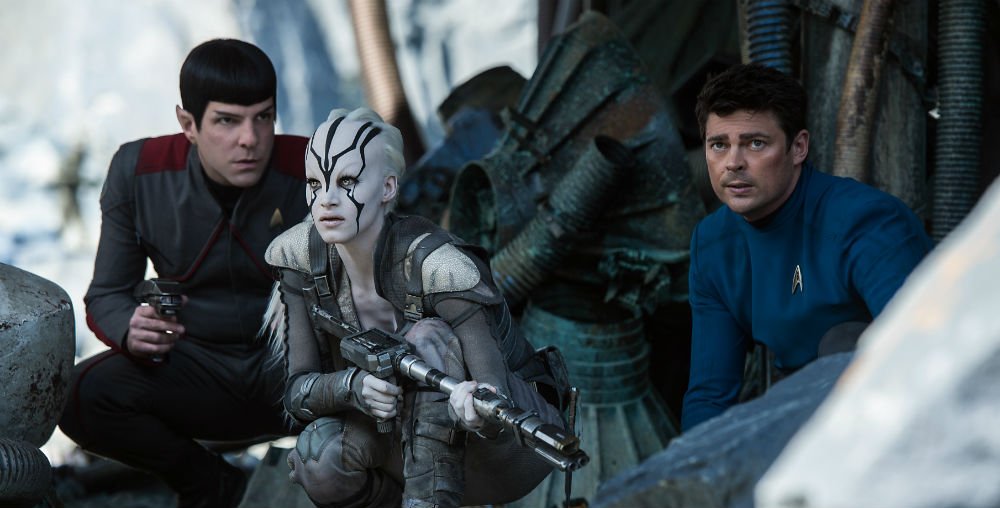
Realising the distress call was merely a set-up for the attack, the crew – now splintered into several pairings after a spectacular crash-landing – attempt to both fend for themselves and regroup to fight the enemy, headed up by the sufficiently nasty Krall (Idris Elba). Of these pairings, Spock and Bones (Karl Urban) make for some #classicbants while Scottie (Pegg) and Jaylah (Sofia Boutella) offer some light relief without the former turning into a comic caricature (it’s a tightrope in places, but Pegg never falls off). It’s testament to Pegg’s writing that he can even find time to wangle in Spaced references (Kirk requesting Scotty “skip to the end”) without it seeming shoehorned.

Whilst Beyond is by no means perfect (Elba’s villain gets suspiciously hammy towards the end, even for a Trek film), it does for Trek what Skyfall did for Bond on its respective 50th anniversary; references and in-jokes are in abundance, but never to the detriment of the film as a whole. It knows it has to service an audience that couldn’t care less about the previous exploits of Spock and Chekhov, whilst also having a weight of fan expectation slung around its shoulders that could have easily been its undoing. (It’s worth noting that tributes both within the film and during its end credits are paid to Leonard Nimoy, the original Spock who passed away during production, and Anton Yelchin who died tragically on June 19th this year aged just 27. It’s already been said that Yelchin's Chekhov won’t be recast, which makes it interesting to see how they'll take the franchise forward in this respect alone.)

As previously noted, Justin Lin is perfectly serviceable as a director – and maybe that’s no bad thing, as he brings no known Trek desires to the table. Sam Mendes proved with Spectre that if you try and twist a franchise to your own ends, i.e. creating a ‘Bond: Greatest Hits’ compilation, it can be your undoing (not that Eon Productions are too bothered in that particular respect, Spectre earning almost $900m worldwide). Lin lets the characters and story do the talking, sticking to the course Abrams has laid out (albeit with less lens flare) without trying to do anything crazily new. Then again, who did the forum trolls blame for Sabotage synched to footage of Kirk on a motorcycle…? As it turns out, I think we can safely blame the writers rather than Mr. Fast & Furious. But knowing how big my grin was when those guitars kicked in, I’d be taking all the blame I could.

Monday, 28 March 2016

Batman v Superman: Dawn of Justice

It was put to me the other day that - with regard to superhero films - "when we were younger we were starved of them". Which is true. It was a non-starter of a genre, deemed by those in charge to be far too niche (how wrong they were). But having too much of a good thing never rang as true as it does now, for this cynical critic at least. As the trailers before Batman v Superman made quite clear, you can't fucking move for them these days. If it's not X-Men: Apocalypse or Captain America: Civil War getting primed to clog up multiplexes the world over, it's the hulking great behemoth of a feature film following the trailers that's currently eating up my time and yours, against our better judgement.

You see I'm tired of all the primary-coloured Marvel bullshit, the desaturated DC denizens and their respective cinematic univii. Yet there I was, buying my ticket like the rest of the helpless herd, willingly putting myself front and centre of the cinema auditorium to be attacked (and it is an attack) by a film I'm already aware is getting mauled by the critics. But I'm forever the optimist, especially where half-decent on-screen superheroes are concerned. And Batman and Superman pretty much sit at the top of that list (unless you're the weirdo who thinks The Phantom is a misunderstood classic). And anyway, how bad can a $250 million movie actually be?

Well as Spider-Man 3 ($258m), The Amazing Spider-Man 2 ($255m - what is it with Spider-Man sequels?) and Avengers: Age of Ultron ($280m) have all proved, you can piss as much money into a film as you like and still fuck it up royally. Only with that much cash to hand, it's done on a grand scale - you can see where the money went. In the case of BvS, the Batcave in particular is a striking piece of set design. In fact there's no hiding it; the producers better see every dollar up on screen, no matter how much of a clusterfuck the finished product is. BvS throws so much costly post-production processing at the screen alone, it's at times akin to watching a dodgy thrice-copied VHS porno. Artificial grain permeates the image beyond all reason. At least in 300 (director Zack Snyder's sophomore feature) it was a justifiable stylistic choice; here it's just visual wankery, deployed because Snyder is trying to create something 'dark' and 'dramatic' (né 'not fun' and 'boring').

While BvS does contain a plot of sorts, I'm at pains to go into it without tearing the proverbial mask off and spoiling the whole show. But the film's rubbish, so I will. After a title sequence recap of why Bruce Wayne became Batman (seeing his parents get shot for a third time, after Burton and Nolan's versions) we're brought up to speed with the final scenes from Man of Steel, replayed from Wayne's point of view. As if you weren't aware of it the first time around, Supes and Zod's showdown definitely killed tens of thousands of people, not to mention toppling a Wayne skyscraper (though it was only their Metropolis branch so, you know, every cloud). Then they went and built a giant Superman statue in his honour, because he saved the world (whilst also killing a fair swathe of its inhabitants). Wayne's clearly furious, therefore SUPERMAN MUST DIE. He's a serious fella too, with serious stubble. He definitely isn't for turning on this one.

As if a Batman/Superman face-off wasn't enough to be excited about, we're then introduced to the rest of the main players - of which there's basically too many. Among them, Lex Luthor - a manchild arsehole of major proportions, portrayed by Jesse Eisenberg in what has to be one of the most dire 'psycho villain' performances in recent memory. It's one thing that his basketball-shooting kid billionaire routine makes you pine for the effortless scenery-chewing charisma of Hackman or Spacey; it's another that no-one else in the film acknowledges it. He's simply allowed to have a shit haircut (solely so he can have it shaved off later, it would seem), make demands for a crashed Krypton spaceship and General Zod's corpse, and casually get away with it. I forget what deal he struck to obtain them, and so will you. You simply won't care enough to remember.

Gal Gadot also shows up as Wonder Woman, though you won't necessarily know that until the end due to her complete lack of personality (not that the script helps in this instance - she's given balls-all to do). She's after a photo, or something - again, the reason why escapes me. And it'll escape you too. Wayne is also visited by a superhero from the future (possibly Nightwing? I don't know, he had a red eyemask on) in a borderline-exciting dream sequence that goes absolutely nowhere. The film is full of these kind of shoehorned plot lines that serve nothing other than to build towards the Justice League film, as if the only reason these films exist nowadays is simply to generate more films. Like a cloning experiment that's gotten horribly out of control. It makes for boring and bleakly depressing viewing.

In other news, whilst Superman is off getting hounded for being a weird alien who answers to no-one, Batman gets busy building a bastard-heavy suit to take him down with (Jeremy Irons' Alfred sits off for most of the film, uttering pointless asides as if he'd forgotten the cameras were rolling). Lex on the other hand ends up stood in a pool of alien water on-board the ship he took charge of. (again, I try and recall how/why he did this... no, nothing.) He forges a dead Zod with his own blood (?!) in some kind of funky Krypto-ritual, in order to create a deformed mutant creature to kill Superman with. He comically notes "It's your Doomsday" (one for the fanboys) when the thing comes to life right on cue, at which point Supes and Bats appear, having made friends after some serious cape-measuring (Batman's was bigger) in order to stand tall and kill this abomination together (I'm kidding of course - the real reason they make friends is because their mother shares the same name. Yes, really). Then Wonder Woman swoops in out of fucking nowhere and chips in with an outfit that really doesn't offer half as much protection as her male counterparts. The whole screen erupts in a cacophony of flames, debris, static and fury, a mindless orgy of (literal) nuclear-grade nonsense that leaves you cheering for precisely no-one whatsoever. It's absolute tedium on the grandest of big-budget scales.

As noted above, neither Batman or Superman actually 'win' in their much-hyped and hashtagged super-battle. That's because 'justice wins', obvs. In fact, the only real winner is the studio judging by the opening weekend box office takings. Money that will no doubt be ploughed into the ongoing experiment to produce more comic book films no matter what the cost, this particular batch being of the aforementioned 'dark' and 'dramatic' variety as a counterpoint to Marvel's primary-coloured bullshit.

I'd love to say we should be grateful for how the tide has turned, the superhero genre bubble on the verge of bursting when Iron Man was announced ("Iron who?" said the great unwashed), only for Ol' Shellhead to kickstart a socio-economic programme designed to punish an audience into submission with film after film the studios KNOW the public will pay to see, no matter where the quality bar is set (Spider-Man 3 = $890m; Age of Ultron = $1.4bn).

Though let it be said, I have no axe to grind here - my dissatisfaction is all-too recent. There's been plenty of fun times blasted out of the comic book cinema canon, not least of all the middle portion of Raimi's Spidey trilogy, which only serves to highlight what a studio-meddled mess the third film is. As an antithesis to said fun times (without actually losing the inherent sense of fun these films should have written into them by law), Nolan's Dark Knight trilogy is for many the holy grail of how superhero cinema can and should be executed - treating the source material with respect, whilst at the same time raising the bar for a once-hokey genre to be compared with Mann's Heat and Coppola's Godfather saga.

Snyder on the other hand seems sadly intent on wiping all traces of fun from the screen, taking legendary characters and making them soulless ciphers, there to do naught except team up in one shot for fanboys to cream over. But surely said fanboys are now as disillusioned as I am with this whole affair. When the Avengers all slo-mowed into frame at the start of Ultron, it was the beginning of the end. As if this money shot is what we've all secretly been waiting for. Well you can stick your money shot, if this is what it adds up to. Poorly-written, scattershot cinema with no genuine heart and soul; just a churning, endless production line of uninspired, open-ended tripe that paves the way for another thousand films just like it.

Now if you don't mind, I'm off to book my tickets for X-Men: Apocalypse and Captain America: Civil War. Might as well, eh.